




Liner vs Concrete Pools
The interior surface of your pool dictates which type of vacuum head you should buy. Using the wrong base can either damage your pool or make the cleaning process frustrating.
- Vinyl Liner and Fibreglass Pools (Use Brushes): If your pool has a softer surface, you must use a vacuum head equipped with nylon brushes. These brushes serve two purposes. First, they gently scrub away clinging dirt and algae without tearing, stretching or scratching the delicate liner. Second, the bristles create a slight gap between the suction port and the pool floor. This prevents the vacuum head from sealing itself flat against the vinyl and getting stuck due to intense pump suction.
- Concrete and Tiled Pools (Use Wheels): Rough, hard surfaces like concrete, gunite or mosaic tiles require a heavy-duty model with wheels. If you were to use a brushed model on concrete, the abrasive surface would wear the bristles flat in a matter of weeks. Wheeled models are specifically weighted to sink to the bottom easily. The wheels allow the head to glide smoothly over textured surfaces while maintaining the perfect distance from the floor, generating a powerful vortex of suction that pulls up heavy debris.
Choosing the Right Shape
When browsing our collection, you will notice different shapes. Each design is engineered to solve a cleaning challenge.
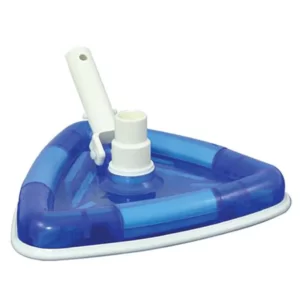
- Triangular Pool Vacuum Heads: If your pool has geometric corners, built-in steps, or awkward crevices, a triangular head is the best choice. The pointed nose allows you to push the suction port deep into 90-degree angles where dirt naturally gathers. Many of these models also feature a swivel cuff for the hose connection, which stops your hose from twisting and tangling as you turn the pole.
- Flexible Rectangular Pool Vacuum Heads: For large, sweeping areas, a wide rectangular model is ideal. The standout option here is the flexible pool vacuum head. These models are constructed with a pliable body and built-in weights. As you push the head from the flat shallow end down the slope toward the deep end, the body bends to contour exactly to the curve of the floor, ensuring you never lose suction on uneven terrain.
Universal Compatibility
We keep our equipment standard so you don’t have to worry about complicated setups. All of our swimming pool vacuum heads are designed with universal fittings:
- The Pole Connection: The handle features a standard internal wishbone clip. You simply squeeze the plastic V-clip, slide it into any standard telescopic pole and let the pins snap securely into the locking holes.
- The Hose Connection: The suction port on top of the head accepts standard 1.5-inch (38mm) pool vacuum hoses. You just push the hose cuff firmly onto the port for an airtight seal.
Pro Techniques for Effective Vacuuming
Having the right Swimming Pool Vacuum Heads is only half the battle; technique matters just as much.
The most common mistake beginners make is moving the vacuum head too fast. Pushing it vigorously creates underwater currents that lift fine silt and algae off the floor and disperse it into the water before the suction can capture it. Always use slow, deliberate and overlapping strokes.
Additionally, if you are vacuuming a heavily soiled pool (such as opening it for the spring), check your filter’s multiport valve. Instead of vacuuming the thick debris into your filter, which will quickly clog it, switch the valve to the “Waste” setting. This bypasses the filter entirely, sending the dirty water straight down the drain and saving you hours of filter cleaning.
Need Help With Choosing a Pool Vacuum Head?
If you are still unsure which swimming pool vacuum head is best suited to your pool’s surface or shape, we are here to help. Our team is dedicated to providing straightforward, practical advice to make your maintenance routine as easy as possible.
Give us a call on 0208 941 6618 or email us here.
